
Old House Renovation Guide: Steps, types, budegts and Notice!

I. Introduction
Old house renovation is a journey filled with anticipation, challenges, and details. Many homeowners choose to purchase an old house not just for its better location, but also for its flexible layout, good natural light and ventilation, and often, architectural features that are hard to replicate in modern buildings. However, the problems of old houses are equally evident, including aging electrical and plumbing systems, structural wear and tear, leaks, efflorescence ( efflorescence), outdated partitions, and insufficient lighting. Facing these issues, the key to a successful renovation lies in mastering the process, finding a suitable decoration style, configuring appropriate indoor lighting, and establishing good communication with the designer.
Many people encounter difficulties during an old house renovation such as hard-to-control budgets, extended construction periods, discrepancies between construction and desired style, poor coordination between trades, or on-site conditions not matching the drawings. These issues largely stem from an unclear process, vague scope of work, and insufficient communication. Therefore, a complete old house renovation guide can not only help homeowners feel more secure during construction but also ensure the renovation results better meet their living needs, avoiding future rework and unnecessary expenses.
This comprehensive guide will delve into the five main stages of old house renovation, important considerations, recommendations for popular styles, lighting design tips, and the most practical indoor lighting selection through clear sections and a full-process mindset. This will allow every homeowner preparing for a renovation to be fully prepared in advance and create a home space that truly reflects their ideal life.
II. Old House Renovation Steps
The success of an old house renovation step depends on making correct and complete decisions at every stage. From current condition assessment to soft decoration installation, every step impacts the budget, timeline, and final result. Understanding the overall process allows homeowners to maintain control throughout the renovation and enables smoother collaboration between the designer and the construction team.
Old House Current Condition Assessment
The current condition assessment of an old house is the starting point of the entire renovation plan and the basis for determining all subsequent design and construction possibilities. The designer, often accompanied by electrical, masonry, and carpentry teams, will inspect the site using their experience to identify potential hazards or issues that need priority handling. These include checking for old aluminum wiring, iron pipes or old PVC water pipes, failed bathroom waterproofing, uneven or hollow floors, wall seepage, and cracks or spalling on beams and columns.
These existing problems are often not easily detectable from the surface. For example, a water pipe may look normal but could be prone to rupture due to age; the wiring may not show signs of burning but could be insufficiently loaded for modern appliances; the bathroom surface might be dry, but the subfloor could be saturated with moisture. If these issues are discovered only after the renovation is complete, it will necessitate tearing down finished work, wasting money and delaying the timeline.
Another crucial purpose of the current condition assessment is to confirm if the structure and regulations can accommodate the homeowner’s needs. For instance, whether partition walls can be removed, if window positions can be changed, if outward expansion is permitted, whether the drainage slope of the pipe shafts will be affected, or if the work involves public walls or load-bearing structures. These factors must be clearly understood during the assessment phase to prevent design proposals from being forcibly changed due to impractical conditions.
Through a complete site inspection, the homeowner can understand the true budget required for the old house and the priorities, ensuring all renovations are built on a safe and durable foundation.
Design and Scope of Work Confirmation
After completing the current condition assessment, the process moves into overall space planning and design direction confirmation. This stage determines the entire look and function of the old house renovation, making complete and precise communication highly important. The designer will consider family members, living habits, style preferences, storage needs, lighting conditions, and budget to provide a practical layout plan. Examples include merging small rooms, replanning the kitchen location, increasing storage space, designing an entryway, or integrating the study with the living room.
Confirmation of the scope of work is equally vital, as every project is related to the budget. If the homeowner wishes to update all electrical and plumbing, redo the bathrooms, demolish all flooring, redo the ceiling, install all built-in carpentry, or replace windows, these are major projects, and the budget must be confirmed to be sufficient. The designer will provide drawings, including the layout plan, ceiling Plan, electrical and plumbing drawing, lighting plan, and elevation drawings, along with material samples and a construction budget estimate, allowing the homeowner to adjust the content according to their own needs.
The design phase is also the best time to establish communication rapport. The clearer the drawings and construction items, the fewer errors on-site; the more confirmed the material samples, the closer the finished product will be to expectations; the clearer the positions of lights and switches, the more convenient the future use. Complete and detailed design planning makes the living space more compliant with living habits and avoids future inconveniences during use.
Protection Engineering
Without comprehensive protection engineering, old house renovation can easily lead to damage to common areas, collisions with elevators, wall scratches, or existing furniture damage during construction. The purpose of protection engineering is to ensure the overall construction process remains clean and safe, and to avoid unnecessary compensation and disputes.
The construction team usually carries out protection before the start of the project in the building’s elevator, stairwells, public corridors, and indoors. This includes laying anti-collision foam, covering furniture with plastic sheeting, sealing off non-working areas, and installing dust-proof curtains. For detached houses or apartment buildings, pipe shafts, stair railings, and staircase corners also require complete protection.
Perfect protection engineering ensures smoother construction flow and prevents different trades from interfering with each other—for example, preventing masonry dust from affecting woodwork, avoiding damage to finished flooring during electrical and plumbing work, or preventing damage to retained items during demolition. These seemingly minor items are actually one of the biggest differences between professional construction and ordinary construction teams, and they directly affect the overall construction quality.
Hard Decoration Engineering
Hard decoration engineering is the most important, complex, time-consuming, and expensive part of the entire old house renovation. It lays the foundation for the space’s safety, durability, and functionality. Hard decoration includes demolition, masonry, electrical and plumbing, carpentry, systematic cabinet installation, kitchen, and bathroom equipment installation. They follow a strict sequence and construction logic and must be completed step-by-step to ensure high quality.
The demolition work removes all unwanted existing decorations, including flooring, cabinets, old partitions, old ceilings, and old kitchen and bathroom fixtures. Only after demolition can the true condition of the walls, floor structure, and pipe configuration be seen, allowing for further confirmation of any additional items.
The masonry work is responsible for partition wall construction, wall plastering, floor leveling, waterproofing, and tile laying. Bathroom waterproofing is particularly important, requiring a complete waterproof layer from the floor to the walls, followed by a 24 to 48-hour water-filling test using instruments to ensure no future seepage.
Electrical and plumbing work is the most crucial hidden project in old house renovation, including wiring updates, water pipe replacements, air conditioning piping, socket position adjustments, and pre-reserved light fixture connection points. These items will affect future living convenience and safety, so they must be completed by qualified technicians.
Carpentry work includes ceiling construction, cabinet structures, door frame adjustments, skirting board installation, and decorative walls. Systematic cabinets are installed after the carpentry is complete according to the design dimensions, providing storage function and visual consistency.
Finally, the kitchen and bathroom fixtures are installed, including man-made stone countertops, cooktops, ovens, dishwashers, water purifiers, vanity cabinets, toilets, showerheads, and glass partitions. These fixtures directly impact the quality of life, so a balance of aesthetics, function, and durability must be considered during selection.
Soft Decoration Engineering
After the hard decoration stage is completed, the old house has a new structure and function, and the soft decoration engineering is responsible for giving the space style and atmosphere. Soft decoration includes furniture selection, curtain design, lighting configuration, art selection, rug pairing, and plant placement. It makes the space complete and can be adjusted as life changes.
The material and size of the furniture determine the space proportions, such as sofa depth, dining table size, bed frame height, and storage methods, all of which need to be selected according to the user’s habits; curtains affect light softness and privacy; rugs can make the living room, study, and bedroom atmosphere warmer; and lighting is one of the most important parts of soft decoration, creating layers, atmosphere, and ambiance.
Soft decoration is the stage that best showcases personal style, so the homeowner should discuss with the designer to find the best combination that is both stylish and functional.
III. Important Considerations for Old House Renovation
While old house renovation seems complex, mastering the correct process and priorities can significantly reduce risks, save budget, and improve overall construction efficiency. Problems in old houses are often hidden beneath the surface, so the renovation steps requires more patience and meticulousness than a new house. However, by adhering to core principles, the overall process can be very smooth, not only improving the quality of life but also giving the space a whole new vitality.
Foundation First Principle: Plumbing, Structure, and Waterproofing
The most important principle in old house renovation is to “prioritize structure over aesthetics.” Because the plumbing and wiring of old houses are often over thirty years old, these aging systems, including corroded water pipes, insufficient electrical load, and failed waterproofing layers, will cause severe problems in later life. Issues like bathroom seepage, electrical aging leading to tripping or short circuits, poor kitchen drainage, wall spalling, and recurring efflorescence are the troubles most often encountered by homeowners after moving in. If the foundation work is not thoroughly addressed at once, the cost of subsequent rework is often several times the original cost and affects normal routine and living safety.
Therefore, problems found during the assessment phase must be prioritized during the hard decoration stage, including re-wiring, replacing water supply and drainage pipes, redoing waterproofing, strengthening the structure, and inspecting beams and columns. Only with a solid foundation can subsequent decoration truly be long-lasting and safe.
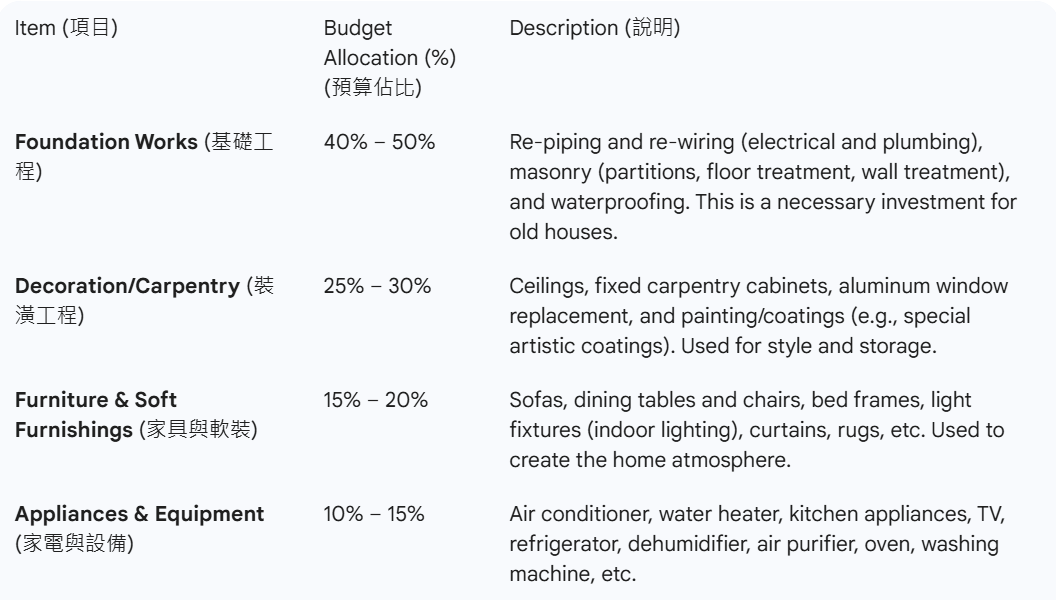
Budget Flexibility: Reserve 10-20% for Contingencies
The most common situation in old house renovation is discovering additional problems only after demolition. These unexpected issues include widespread pipe corrosion, damp floor slabs, termites in the walls, poor drainage slope design, wiring that does not meet current safety regulations, or even insufficient material quantities in the original calculation. These all lead to an increase in the construction budget. Unlike new houses, many problems in old houses only become clearly visible after demolition, so a lack of budget flexibility can easily cause a halt in later construction.
Professional designers therefore suggest that homeowners reserve 10–20% of the budget for contingencies. Do not invest all funds in hard and soft decoration, allowing the money to be used flexibly to avoid having to lower construction quality or sacrifice functional needs due to insufficient budget.
Regulations and Permits: Avoid Illegal Construction or Unpermitted Renovations
Many old houses are located in apartments, townhouses, or multi-unit buildings, where shared structures and usage regulations must be followed. For example, load-bearing walls cannot be arbitrarily removed, balconies cannot be enclosed, stairwells or public areas cannot be occupied without permission, external walls cannot be arbitrarily modified, and the location of air conditioning outdoor units must comply with regulations and community rules. Proceeding with construction without application may lead to fines, demolition, or even structural hazards to neighbors, causing unnecessary disputes.
Before old house renovation, it is essential to confirm relevant regulations and, if necessary, entrust a professional designer to assist with the application process, ensuring the entire project is legal, safe, and free of future disputes.
Designer Communication: Confirming Drawing Details and Material Samples
Old house renovation requires confirmation of more details than general decoration, including layout plan, ceiling Plan, electrical and plumbing drawing, lighting plan, elevation drawings, storage design, material samples, lighting configuration, and color matching. Relying solely on verbal communication can easily lead to construction discrepancies due to different interpretations, eventually requiring rework, modifications, or misunderstandings with the construction team. Therefore, it is imperative to require all details to be “on the drawings” and to use actual samples as the final confirmation basis.
Maintaining sufficient communication with the designer ensures more accurate construction and a more stable grasp of the budget and timeline. The more complete the drawings, the fewer ambiguous areas on-site, and the smoother the renovation steps will naturally be.
Prioritizing Living Habits and Function: Do Not Sacrifice Practicality for Style
Many homeowners, when planning a renovation, are easily attracted by exquisite photos and overlook the demands of their living habits. If one blindly pursues a style while neglecting storage capacity, circulation paths, actual cooking needs, light source configuration, and activity space, they often find it impractical after moving in and may even need modifications.
Old house renovation should prioritize “living needs” first, and then decide on style and materials. For example, someone who loves cooking needs a larger countertop and a comprehensive range hood system; a home with children requires rounded corners, non-slip flooring, and scratch-resistant materials; someone who rarely cooks can focus on storage, living room comfort, or bedroom function. Only when function meets living needs will aesthetics become a true bonus, not a burden.
IV. Recommended Decoration Styles
The style of an old house renovation determines the overall atmosphere and is a crucial factor in reshaping the inhabitants’ way of life. Different styles can not only solve common problems of old houses, such as insufficient lighting, restricted layouts, exposed beams, and lack of storage, but also showcase the inhabitant’s personality and aesthetic taste. The following six styles are currently the most popular on the market and the most suitable for application in old house renovations:
Scandinavian Style Decoration
Scandinavian style centers on nature, comfort, and softness, preferring to keep the space pure, bright, and filled with a sense of warmth. Common color schemes include white, light wood, grey, and pale beige. These soft tones visually enlarge the space, making it very suitable for the generally dim and poorly-lit conditions of old houses. Through large areas of white space, clean, sharp lines, and natural wood elements, Scandinavian style can inject a brighter and fresher atmosphere into an old house.
The interior often features light sheer curtains, warm wooden floors, and furniture made of leather or cotton/linen, making the overall space feel free, stress-free, simple, yet enduring. If a warm Scandinavian feel is desired, soft warm-white lighting can be paired to create a smoother ambiance.

Old House Renovation Design: Create A Scandinavian Home with Sunshine and Artistic Texture!
Modern Style Decoration
Modern style emphasizes sharp, stable spatial language, primarily using low-saturation grey, white, black, and wood tones. The lines are simple and clean, with visual layers mainly presented through material changes and light and shadow, without excessive decoration, making it easier to integrate existing flaws in the old house. Modern style decoration focuses on extensive storage, hidden cabinets, and sharp edge finishing techniques, which are very suitable for improving old house problems like irregular spaces, oppressive beams, wall cracks, or exposed pipes.
By consolidating cabinets and replanning circulation and lighting layers, an old house can instantly have a renewed modern feel. Modern style is also particularly suitable for small-sized old houses because it uses visual segments and linear language to create a clean and open sensation.

Old House Renovation|A Modern Style Home with Elegance, and Contemporary Comfort!
Cream Style Decoration
Cream style is dominated by soft tones like cream, off-white, and light khaki, as if applying a soft-focus filter to the space. This style has gained immense popularity in recent years, not only looking soothing and clean but also very suitable for families who want a gentle atmosphere after an old house renovation. Cream style often incorporates rounded shapes, curved cabinets, and linear designs without sharp edges, and uses warm, bright lighting to make the space feel soft and relaxing.
If the old house itself has weaker natural light, bright wall colors and reflective materials can be used to make the overall space more open. Furniture choices tend towards low saturation, rounded lines, and soft materials, which can create a very soothing and comfortable home. Cream style’s comforting texture is very suitable for singles, couples, or small families.

Old House Renovation|A Cream Style Home with Soft, Elegance, and Healing!
Light Luxury Style Decoration
Light luxury style focuses on “understated sophistication,” using details like metal, glass, marble, and high-gloss materials to create a sense of high-end without being as flamboyant as traditional luxury styles. This style is particularly suitable for old houses with a larger indoor layout, higher ceilings, or large floor-to-ceiling windows, as it can fully showcase the texture and luster of the materials. Light luxury style emphasizes material pairing, such as metallic lines accentuating the TV wall, glass screens increasing transparency, and marble countertops enhancing texture.
Through delicate lighting, such as linear lights, indirect lighting, and accent lighting, the texture of the materials can be presented even more perfectly. When an old house is properly renovated, pairing it with a light luxury style can make the overall visual effect refined, stable, and modernly tasteful.

Old House Renovation|A luxury Home with Elegant, Unique, and Exceptional Feeling!
Industrial Style Decoration
Industrial style emphasizes raw, rugged textures, preferring to preserve the space’s true appearance, including fair-faced concrete, metal fixtures, exposed ceilings, brick walls, and rough wood veneers. This style is especially suitable for old houses with historical traces, as many old houses already have brick walls or concrete structures. Simply preserving and slightly refining them can showcase a unique spatial charm.
Industrial style values openness, often using open shelving, metal light fixtures, and wooden furniture to create a free and unrestrained atmosphere. If exposed beams and columns in an old house affect the original style, industrial style can transform these structures from flaws into features. The color palette composed of black, grey, and brown also enhances the stability and personality of the space.

Industrial Interior Design|Best Designer-Loved Colors, Materials, and Lighting!
Japanese Style Decoration
Japanese style is known for nature, tranquility, and minimalism. Common elements include wood, fabric, sliding doors, screens (grilles), and large areas of white space. This style is particularly suitable for families who want to create a quiet pace of life and enjoy a comfortable, minimalist atmosphere. When renovating an old house, pairing it with warm wood tones, soft lighting, clean lines, and simple furniture can create a living space that is comfortable and soothing, much like a traditional Japanese home.
Japanese style focuses on the tactile and natural quality of the materials themselves. Therefore, if an old house wishes to showcase the warmth of wood, integrate storage functions, or create a clean, open living circulation, Japanese style is quite suitable. Furthermore, screens and sliding doors can enhance the lightness and flexibility of the space, which is also very friendly to small spaces in old houses.

Japanese Interior Design: Japanese Furniture & 7 Lighting Fixtures Selection Tips!
V. How to Design Lighting for Old House Renovation?
Lighting design is a critical part of old house renovation. It not only affects the visual atmosphere but also addresses common old house problems like insufficient lighting, dark spaces, and low ceilings. Correct lighting configuration can make the space more open, the style clearer, and the functionality stronger.
Multi-layered Lighting
The use of multi-layered lighting is indispensable for old houses. If a space only has a single main light, it easily causes strong shadows, uneven light, insufficient brightness, or excessive glare. Therefore, old house renovation should combine main lighting, auxiliary lighting, and mood lighting to make the light distribution more natural and the layers richer.
The living room usually uses recessed downlights as the main light source, supplemented by wall lights, floor lamps, and localized LED strips, giving the space depth in addition to brightness, and making it less monotonous. The bedroom focuses on soft light, with the addition of bedside table lamps or cabinet light strips to create a relaxed resting ambiance. By using a combination of multiple light sources, even if the old house has limited natural light, it can still achieve a bright, natural, and non-glaring visual effect.
High, Medium, and Low-Position Lighting
The concept of high, medium, and low-position lighting makes the light more three-dimensional, preventing the old house from feeling oppressive due to insufficient height or old structures. High-position lighting usually includes recessed downlights, pendant lights, ceiling lights, or ceiling indirect lighting, providing overall brightness and preventing the space from looking dull. Medium-position lighting includes dining pendant lights, floor lamps, wall lights, and table lamps, supplementing brightness in work and high-activity areas, making circulation safer and visuals more comfortable.
Low-position lighting, such as stair lights, skirting lights, and indirect light sources under furniture, provides gentle visual guidance at night, avoiding glare while giving the space more warmth and subtly magnifying the indoor depth and layers. When these three levels of light work simultaneously, the oppressive feeling of the old house will be significantly reduced, replaced by a spacious, soft, and layered living atmosphere.
Correctly Choosing the Lighting Color Temperature
Choosing the lighting color temperature is also crucial for old house renovation. Residential spaces are best suited for 3000K–4000K warm white or natural light. This color temperature range allows the old house to present a warm and comfortable atmosphere, neither too yellow nor as harsh and cold as cool white light.
Especially in old houses that often use wood, grey-white base tones, or stone elements, pairing them with 3000K–4000K enhances the texture of the materials and strengthens visual comfort. This color temperature also provides a relaxing feeling at night, making home life more pleasant.
Lighting Design with a Ceiling
If a ceiling is installed during the old house renovation, the flexibility of lighting configuration is significantly increased. Recessed downlights can evenly distribute brightness, while indirect lighting strips make the light softer, reducing shadows and enhancing the space’s atmosphere. The ceiling can also hide air conditioning copper pipes, electrical wires, and network cables, making the overall visual effect cleaner. Layered ceiling design can also be used to reduce the sense of beam oppression, making the old house look more modern and comfortable.
Furthermore, the main light can be paired with recessed downlights or light strips, providing both basic brightness and mood lighting to meet the usage needs at different times.
Lighting Design Without a Ceiling
If the old house does not install a ceiling, the lighting plan will focus on exposed fixtures, such as track lights, ceiling lights, and wall lights. Track lights are very suitable for old houses because their angle can be freely adjusted to reinforce dark corners, highlight display shelves, the sofa back wall, or artwork, enriching the spatial layers.
Many designers use track lights to replace major ceiling construction, avoiding lowering the ceiling height and saving construction time. Track lights can be focused or scattered, suitable for modifying the old house’s original structure or highlighting feature walls.
In addition, LED strip lights can be installed on cabinet edges, wall lines, or under furniture to form warm indirect light, making the old house look more modern and clean, and improving visual shadow problems.
VI. Recommended Interior Design Light Fixtures
One thing interior designers emphasize most during old house renovation is that “choosing the right light fixtures can elevate the space quality by several levels.” Suitable light fixtures not only provide light but also shape the atmosphere, increase material layers, cover flaws, and even reverse the entire visual impression of the space. The following light fixtures are most often recommended by interior designers for use in old house renovations:
ARC Recessed Downlights/ Full-Spectrum Recessed Downlights
The ARC Recessed Downlights/ Full-Spectrum Recessed Downlights are high-specification recessed downlights using full-spectrum light sources, making them one of the most popular choices for main lighting in many old house renovation cases. Full-spectrum light sources allow colors in the space to appear more true, without being yellowish or greyish, especially suitable for spaces that use a lot of wood veneer, stone, or cream tones. Their curved light cup design makes the light softer, avoiding the formation of glaring bright spots and making the occupants feel natural and comfortable.
Designers often use this downlight in living rooms, corridors, and bedrooms because it can provide sufficient brightness and soft light simultaneously, which is particularly effective in the dim layouts of old houses.


HIDE Deep Anti-Glare Recessed Downlights
The HIDE Deep Anti-Glare Recessed Downlights are another highly functional recessed downlight. Its anti-glare design effectively reduces the harshness caused by direct light source exposure, making the light more focused and cleaner. Old houses often have shadows or reflections due to scattered beams and uneven walls, and deep anti-glare downlights can improve this visual interference, making the light more stable.
It is very suitable for use in the living room TV wall, dining area, or reading spaces, allowing family members to maintain comfort even during long periods of activity. Its understated appearance can also blend into various styles without causing a visual burden.


MINI IP Waterproof Downlights
The MINI IP Waterproof Downlights are very practical in old house renovation, especially in bathrooms, outer balconies of entryways, or damp areas. Many old house bathrooms have insufficient light and are small, often feeling oppressive. The MINI IP Waterproof Downlights are small in size and bright enough, making them very suitable for multi-point arrangement, effectively increasing brightness without taking up space. Due to their IP44 waterproof function, they can also maintain long-term stability in humid environments, avoiding the common problem of shortened light fixture life in old houses.


Apollo Track Lights
The Apollo Track Lights are one of the best solutions when an old house does not install a ceiling. The advantage of track lights is that their angle can be adjusted freely. They can provide localized lighting for dark corners, display shelves, the sofa back wall, or wall art, enriching the spatial layers.
Many designers use track lights to replace major ceiling construction, avoiding lowering the ceiling height and saving construction time. Track lights can be focused or scattered, suitable for modifying the old house’s original structure or highlighting characteristic walls.


LED Strip Lights/ Light Strips
LED strip lights and light strips are one of the fastest ways to enhance quality in old house renovation. Light strips can be hidden in ceiling lines, under cabinet edges, behind the bed headboard, or in TV wall features, providing a soft indirect light source that makes the space feel warm and light. They do not cause oppression and can visually extend the space, making them particularly suitable for old houses with narrow spaces or insufficient light. Designers often use light strips to compensate for shadowed areas, increase atmosphere, and emphasize linear structures, making the space look more modern.


Quintus Ceiling Downlights
The Quintus Ceiling Downlights are a savior for old houses with low ceilings. Many old houses are not suitable for large pendant lights or recessed downlights due to lower floor heights or complex beams. Ceiling downlights have a simple shape and concentrated light effect, providing good brightness without reducing the ceiling height. They are suitable for use in living rooms, hallways, entryways, and bedrooms. Their shape is clean and space-saving, making them a choice that balances style and practicality.


Decorative Lighting Fixtures (Pendant Lights, Wall Lights, Table Lamps, Floor Lamps)
Decorative lighting fixtures such as pendant lights, wall lights, table lamps, and floor lamps play an important role in adding value to the space. A pendant light can define the center point of the dining table or living room, creating a visual focus; a wall light can soften the light and shadow on the wall, giving the space more ambiance; table and floor lamps provide localized lighting, making reading, resting, or watching movies more comfortable at night.
During old house renovation, simply adding a few decorative light fixtures that suit the style can immediately enhance the space’s atmosphere and taste, achieving the effect that “light is design.”


Conclusion
Old house renovation is a challenging but worthwhile journey. Through a complete old house renovation steps, assistance from a professional designer, reasonable budget control, and correct lighting design, the house’s original structural problems can be solved, and new vitality can be injected into the space. Choosing a suitable decoration style and indoor light fixtures can also make the inhabitants feel truly comfortable, safe, and aesthetic. By mastering the comprehensive guide provided in this article, creating an ideal home that balances style, function, and quality will no longer be a difficult task.
View more interior design projects and interior design case studies
Welcome to contact us for Home Lighting Design and Home Lighting procurement!
Website: https://tj2lighting.com
Whatsapp: +886 988147729
Phone: +886 4-2534-1768
E-mail: sales@tj2lighting.com
Line: @034wnuyy
More Information:
American Interior Design|Home Lighting Design Tips Designers Recommend!
MUJI Interior Design|Home Lighting Design Tips Designers Recommend!
Industrial Interior Design|Home Lighting Design Tips Designers Swear By!
Modern Interior Design and Home Lighting: Interior Designers’ Top Tips for a luxury, Stylish Home!
Nordic Interior Design and Home Lighting: Interior Designers’ Top Tips for a Cozy, Stylish Home
DIY Home Decor | 6 Tips for Choosing Light Fixtures and Planning Home Lighting!
Use Home Lighting to Make Your Small House Look Bigger! Interior Design
How LED downlights and Lighting design Enhance Your Home?
Living Room Lighting Design: Using Layers and Contrast to Create a Luxurious Space
| Recommend Home Lighting Fixtures
| Related Articles
-
Home Lighting Manufacturers and Suppliers | Bedroom Lighting Design/Bedroom Lighting Fixtures | Commercial Lighting | Home Lighting | Illumination in Practice | Indoor Lighting | Indoor Lighting Manufacturers and Suppliers | Living Room Lighting Design/Living Room Lighting Fixtures
Choosing Downlights Height And Size: Professional Specifications For Designers!
I. Introduction In the realm of contemporary space planning, the interplay of light and shadow is often the final key to determining…
-
Indoor Lighting | Bedroom Lighting Design/Bedroom Lighting Fixtures | Commercial Lighting | Home Lighting | Illumination in Practice | Indoor Lighting Manufacturers and Suppliers | LED Lighting Manufacturer | Living Room Lighting Design/Living Room Lighting Fixtures
Lighting Size and Height Guide: Professional Specifications For Home Interiors!
I. Introduction: The Key to Lighting Aesthetics—Precision in Fixture Specifications In the professional field of interior design, lighting configuration is never just…
-
Home Decor Styles/ Ideas | DIY Home Decor Ideas and DIY Projects | Home Lighting | Illumination in Practice | Indoor Lighting | Interior Design Projects and Case Studies | Nordic Interior Design/Scandinavian Interior Design Projects and Cases
Scandinavian Interior Design|5 Lighting Design Tips To Upgrade Your Home!
Introduction Scandinavian interior design is renowned for its simplicity, natural elements, and comfort, making it one of the most desirable home styles…


Download The New Lighting Catalogue
Our latest lighting catalogue has been released! Product lines include indoor, outdoor and commercial lighting items.
Try to get more product information for your projects and requirements. Contact us immediately!

TJ2 Lighting | led lighting manufacturer, lighting manufacturer in Taiwan
TJ2 specializes in indoor, commercial and outdoor lighting, including led downlights, ceiling lights, track lights, spotlights, wall lights, in-ground lights, bollards and downlight modules with various types of models and customized products available.
As a premier led lighting manufacturer and lighting supplier in Taiwan, we are dedicated to catering to a wide range of lighting demands.


