
Lighting Design Guide: 5 Home Lighting Tips to Create a Luxury Feel on a Budget

I. Introduction
In modern interior design, lighting design has long been more than just “lighting up a space.” It is a key element that affects the overall texture, atmosphere, and quality of life. When planning a home space, many people often focus on furniture selection and interior design style but overlook the importance of indoor lighting fixtures and home lighting. This results in spaces that, despite high budgets, still lack layering and a high-end feel.
In fact, professional designers regard lighting design as one of the cores when performing interior design planning. Through the coordination of brightness, angles, and color temperatures of home lighting, it can not only amplify the overall sense of indoor space but also create a warm, relaxing, or sophisticated living atmosphere. More importantly, good home lighting planning does not necessarily require a high budget. As long as you master the key principles, fixture selection, and layout techniques, even light renovations or small budgets can present lighting effects comparable to high-end residences and luxury homes.
This article will start from a professional designer’s perspective to help you fully understand the core logic of lighting design and deeply analyze the five secrets of home lighting and the key points of purchasing indoor lighting fixtures, helping you create an ideal space that is both practical and textured.
Learn More:
11 Interior Design Styles and trends 2026: Popular Styles for designers and Architects!
Indoor Lighting / Home Lighting — Professional LED Lighting Manufacturer and Supplier
II. The Purpose of Planning Home Lighting
The most fundamental purpose of home lighting planning lies in improving the quality of life. Lighting is not just a functional existence; it is an important factor affecting emotions and spatial atmosphere. When lighting design is done well, the space will appear more comfortable and relaxing, and it can also enhance the psychological feelings of the residents, making the home a true place of rest.
From a functional level, lighting design needs to meet various needs of daily life, such as reading, cooking, working, and resting. Different activities require different brightness and light angles. If one relies solely on a single main light, it is easy to cause insufficient light or excessive glare, affecting the user experience. Therefore, through multi-layered indoor lighting fixtures configuration, various life scenes can be accurately addressed.
From an aesthetic level, home lighting plays the role of shaping the spatial atmosphere. Through the changes of light and shadow, spatial structures can be emphasized, material textures can be enhanced, and even ordinary home decor can present a high-end feel. For example, indirect lighting can soften spatial boundaries, while accent lighting can highlight artworks and wall details, making the overall design more layered and deep.
Therefore, a complete lighting design should simultaneously take into account functionality and aesthetics, allowing the home space to achieve a balance between daily use and visual experience.

Learn More: Lighting Design Guide: 6 Interior Design Styles and Fixtures Selection Tips!
III. 5 Key Tips of Home Lighting
1. Life-Oriented Planning of Home Lighting: People-Oriented, Starting from Usage Needs
Among all lighting design principles, the most important point is to be people-oriented. When designers plan home lighting, they do not start from the fixture styles or visual effects first, but prioritize considering the user’s living habits, daily schedules, and actual movement paths to ensure that every light source can truly serve daily life.
For example, whether the living room is often used for reading or binge-watching, whether the dining room emphasizes the dining atmosphere, and whether the bedroom needs light that relaxes and aids sleep—these details will directly affect the configuration of indoor lighting fixtures. Taking the living room as an example, if family members are accustomed to reading on the sofa or using mobile phones for a long time, in addition to basic lighting, it is also necessary to pair with floor lamps or table lamps to provide local and soft functional lighting to avoid eye fatigue. Meanwhile, if there is a need to watch TV, direct light from the main lamp onto the screen should be avoided, switching to side lighting or indirect lighting to reduce contrast and improve visual comfort. Furthermore, if there are elders or children in the home, the brightness and uniformity of lighting also need special consideration to enhance safety.
Therefore, good home lighting should start from real usage needs, so that every lamp possesses clear functions and existential value, rather than just becoming a decoration. When lighting is truly close to life, the overall space will naturally present a comfortable and high-quality atmosphere.

2. Systematic Planning of Home Lighting: Distinguishing Functions of Each Space, Designing Lighting According to Function and Purpose
Different spaces have different usage purposes; therefore, lighting design must possess a clear systematic nature. When designers conduct planning, they usually first divide the home space into public areas, private domains, and transition spaces, and design corresponding lighting configurations based on the functions and frequency of use of each area, making the overall home lighting more logical.
For example, the living room and dining room belong to public spaces; besides needing basic brightness, they also need to account for atmosphere creation and social needs, thus combining multiple light sources. The kitchen emphasizes high brightness and uniform illumination to ensure safety and precision during the cooking process. The bedroom, as a resting space, leans towards low-contrast, soft light sources to help relax the body and mind. The bathroom, besides functional lighting, must also consider waterproofing and safety. Additionally, transition spaces like entrances and hallways, although the stay time is short, still need appropriate lighting to guide movement and connect different areas. If these details are ignored, it is easy to create a sense of abruptness during spatial transitions.
Through such systematic planning, not only can messy lighting configurations be avoided, but the overall interior design can also be more consistent and professional, allowing every space to exert its maximum value.


3. Layered Lighting Design: Distinguishing Basic Lighting, Accent Lighting, Functional Lighting, and Ambient Lighting
A sense of layering is one of the key factors determining whether a space has a high-end feel. In a lighting environment lacking layers, the space often appears monotonous and lacks depth; whereas through multi-layered lighting design, rich changes of light and shadow can be created, making the space more three-dimensional and design-oriented.
In lighting design, layered lighting is mainly divided into four types. Basic lighting is responsible for providing overall brightness, usually composed of downlights, ceiling lights, or ceiling indirect lighting. Accent lighting is used to highlight focal points in the space, such as artworks or featured walls, primarily composed of track lights or adjustable downlights. Functional lighting targets specific needs such as reading, working, or cooking, such as cabinet lights. Ambient lighting creates spatial mood and texture through indirect light sources, led strip lights, or wall lights.
When these different types of light sources are matched with each other, the space will present rich and layered light and shadow effects. For example, setting indirect lighting behind the TV wall can not only reduce visual fatigue but also increase spatial depth. Adding led strip lights under cabinets can create a floating effect, making the space appear lighter. Pairing with local functional fixtures can improve usage convenience.
This multi-layered lighting configuration is one of the core methods for designers to create high-end spaces. Even with a limited budget, as long as you master the use of layered lighting skills, you can significantly enhance the overall home texture.

4. Continuous Planning of Home Lighting: Consistent Color Temperature in Adjacent Spaces to Maintain Overall Texture and Atmosphere
Many home spaces look insufficiently high-end often because the lighting lacks continuity. When different areas use color temperatures or light styles with too much variation, it creates a noticeable sense of fragmentation in the space, affecting overall visual fluidity and comfort.
In home lighting planning, the color temperature of adjacent spaces should strive to remain consistent. For example, it is recommended that the living room and dining room uniformly use 4000K natural light. This makes the space more coordinated visually and easier to create an overall atmosphere. If certain areas require special effects—for example, the bedroom wanting to be warmer or the study needing to be brighter—adjustments should be made through local lighting rather than changing the overall color temperature entirely. In addition to color temperature, the distribution of light and the rhythm of brightness also need to remain consistent. For instance, in an open-plan space, the arrangement of fixtures and the density of light sources should possess continuity, avoiding one area being too bright and another too dark, which causes visual imbalance.
Through continuous lighting design, the overall space can be more fluid and natural visually, further enhancing the completeness and high-end feel of the interior design.


5. Focused Planning of Home Lighting: Use of Professional Angles and Wall-Washing Effects to Create Visual Focus with Light
In interior design, appropriate visual focus can make a space more layered and attractive, and lighting design is precisely an important tool for shaping focus. Designers usually use precise beam angles and irradiation positions to make specific areas become visual centers, enhancing overall spatial texture. A common practice is to use narrow-angle fixtures, such as 15-degree or 24-degree beam angles, to perform accent lighting on artworks, paintings, or collectibles, concentrating the light on the subject to form a contrast between light and dark, further strengthening the visual effect. Meanwhile, it can also avoid light spill, maintaining the cleanliness of the overall space. Additionally, wall lighting is also an important method for enhancing spatial texture. Through 24-degree or 36-degree downlights for wall-washing lighting, light can be evenly distributed on the wall, highlighting material textures and three-dimensional layers, particularly suitable for stone, special coatings, or wooden walls.
Furthermore, accent lighting can also be combined with movement paths, such as setting a visual focus at the entrance or setting a light and shadow end-view at the end of a hallway, making the space more design-oriented and guiding.

IV. Key Tips for Purchasing Indoor Lighting Fixtures
1. Selection of Fixture Color Temperature
Color temperature is one of the key factors affecting spatial atmosphere and visual comfort, and it is also the most basic yet most easily overlooked point in home lighting planning. In most interior design scenarios, it is recommended to focus on 4000K natural light. Such light is neither too yellow and dim nor too cold and white to create a sense of distance, achieving a good balance between comfort and brightness.
In practical application, different spaces can be finely adjusted according to functions and usage scenarios. For example, bedrooms are suitable for warm light closer to 3000K, which helps relax the body and mind and creates a warm atmosphere. The living room should choose 4000K natural light, accounting for both interaction and rest. The study or work area can choose 4000K or 5000K to improve focus and clarity.
Beyond the setting of a single space, the consistency of color temperature in the overall home lighting is more important. If the color temperature difference between different areas is too large, it will create a sense of fragmentation in the space, affecting the overall texture. Therefore, it is recommended to follow the principle of “large-scale unification, small-scale fine-tuning,” using local fixtures for atmosphere changes rather than comprehensively changing the light source color temperature.
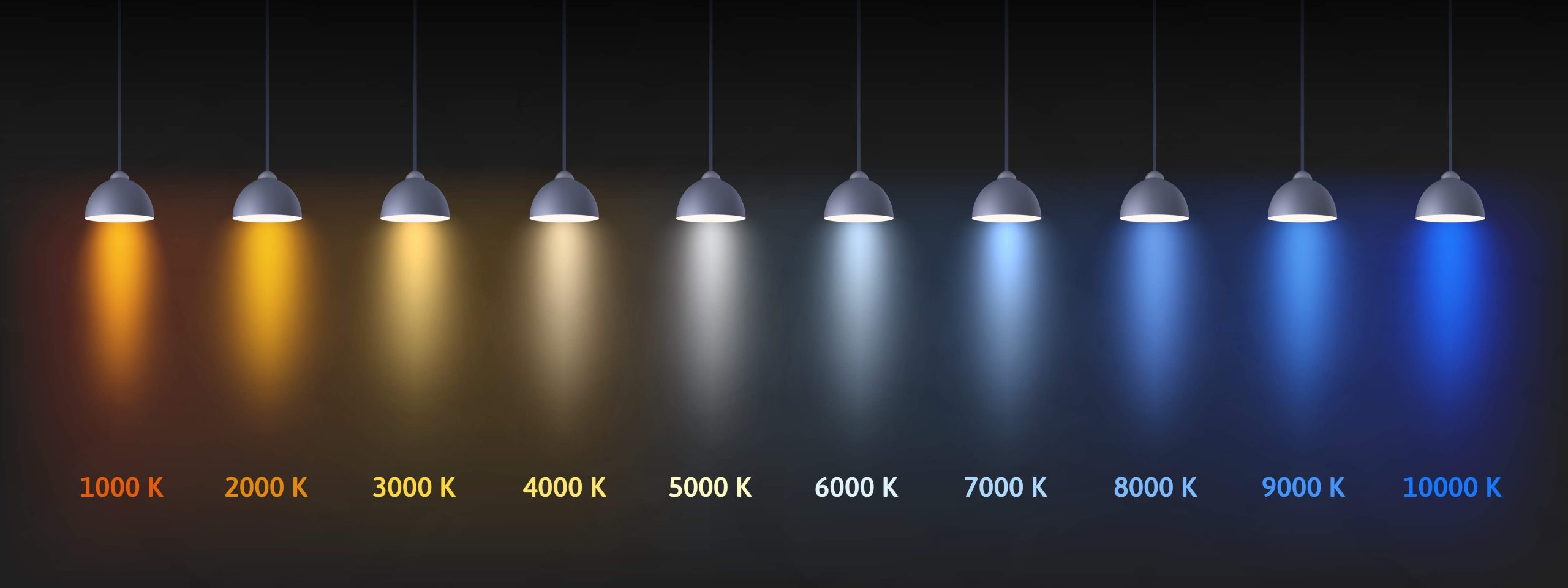
Learn More: Choosing The Right Color Temperature: An Designer’s Guide To Enhancing Your Home Lighting!
2. Selection of Fixture Color Rendering Index (CRI)
The Color Rendering Index is an important indicator for measuring the ability of a light source to restore the true color of objects, having a direct impact on the overall spatial texture. When purchasing indoor lighting fixtures, it is generally recommended to choose light sources with a CRI Ra of 90 or above. This allows furniture, walls, floors, and decorations to present more natural and delicate color layers. If low CRI fixtures are used, even if the spatial design is exquisite, the overall effect may still appear gray or distorted, especially when displaying artworks, hanging paintings, or high-quality building materials, where shortcomings are more easily exposed. Therefore, high CRI fixtures are almost a basic standard for all professional designers.
In practical application, the living room and dining room are the areas that need high CRI the most, as these spaces not only carry daily life but are also where visual focus lies. Especially using high CRI fixtures above the dining table can make food colors more enticing, enhancing the dining experience. Overall, although CRI is a relatively technical parameter, it is a vital key in determining spatial texture. For those pursuing high-quality home lighting, it absolutely cannot be ignored.

Learn More: CRI(Color Rendering Index)-Lighting terms and definitions
3. Fixture Dimensions and Spatial Proportions
The matching of fixture dimensions and spatial proportions is an important factor affecting visual balance and is also one of the basic principles in interior design. If fixture dimensions are chosen improperly, it easily causes spatial oppression or imbalance; even if other designs are perfect, it is difficult to present the ideal effect.
For example, in a living room space, the size of the main lamp or pendant lights should be determined based on the square footage of the space and the ceiling height. If the space is small but a fixture that is too large is chosen, it will create a sense of oppression. Conversely, if the space is spacious but a fixture that is too small is used, it will appear imbalanced in proportion and lack a center of gravity. Dining room pendant lights need special attention regarding their proportional relationship with the dining table. Generally, it is recommended that the fixture width does not exceed 1/2 to 2/3 of the dining table width, and an appropriate hanging height should be maintained to achieve the effect of visual concentration and spatial balance.
Additionally, when planning downlights or ceiling lighting, the spacing and arrangement of fixtures must also be considered, avoiding being too dense or too sparse, which affects the overall lighting uniformity. Designers usually ensure that light distribution and spatial proportions reach the best state through prior configuration maps and simulations.
Learn More: Lighting Size and Height Guide: Professional Specifications For Home Interiors!
4. Matching Fixture Style with Interior Design Style
In modern interior design, fixtures are not just lighting tools but also one of the important elements constituting spatial style. Different types of fixtures will directly affect the overall visual language; therefore, when choosing, they must remain consistent with the interior design style to present a complete and coordinated effect.
For example, modern style spaces usually choose fixtures with simple lines and clean shapes to highlight minimalist texture. Light luxury styles prefer metal materials or fixtures with detailed designs to enhance spatial sophistication. Industrial styles often use black metal and exposed light sources, emphasizing personality and ruggedness.
In addition to the style of a single fixture, attention also needs to be paid to the matching consistency among overall indoor lighting fixtures. For example, the design language of fixtures in the living room, dining room, and hallways should possess continuity, avoiding visual chaos caused by different styles in each space. Through consistent style fixture selection, not only can the spatial theme be strengthened, but the overall home lighting can also be more design-oriented and high-end.

5. Waterproof and Dustproof Ratings of Fixtures
In specific spaces, the waterproof and dustproof ratings of fixtures are key factors for ensuring safety and durability, especially in areas with heavy moisture or harsh environments where this indicator requires special attention.
For example, in a bathroom space, due to long-term contact with moisture, it is recommended to choose fixtures equipped with a protection rating of IP44 or above to prevent moisture from entering and causing damage or safety issues. Furthermore, for specific products such as the Mini IP waterproof downlights, their protection rating should reach IP44. Outdoor spaces such as balconies or courtyards need to face rain, dust, and climate changes; therefore, fixtures need to possess higher waterproof and dustproof capabilities to ensure stable operation over a long period.
Beyond safety, appropriate protection ratings can also extend the service life of fixtures, reducing maintenance and replacement costs. In the long run, choosing fixtures that meet environmental needs is not only safer but also more economically efficient.

Learn More: IP Ratings-Lighting Terms and Definitions
V. Conclusion
Lighting design is an indispensable part of creating a high-quality home space. Through life-oriented, systematic, layered lighting, continuous, and focused planning, even under a limited budget, a home environment with a sense of design and a high-end atmosphere can be created. Meanwhile, in the selection of indoor lighting fixtures, from color temperature and CRI to dimensional proportions and style matching, every detail will affect the final presentation. When these elements harmonize with each other, the space is not only more practical but can also showcase a professional level like that of a designer.
Ultimately, good home lighting is not about stacking expensive equipment, but about letting light become the soul of the space through precise planning and mastery of details. As long as you master the correct lighting design methods, everyone can build an ideal residence that possesses both beauty and function.
View more interior design projects and interior design case studies
More Information:
Indirect Lighting Design Guide:Creating Luxurious Ambiance For Your Home | Interior Design
TOP 10 Interior design styles: Furniture Arrangement + Lighting Selection!
Top 10 LED Lighting Manufacturers in the World 【2025 updated】
American Interior Design|Home Lighting Design Tips Designers Recommend!
MUJI Interior Design|Home Lighting Design Tips Designers Recommend!
Industrial Interior Design|Home Lighting Design Tips Designers Swear By!
Modern Interior Design and Home Lighting: Interior Designers’ Top Tips for a luxury, Stylish Home!
Nordic Interior Design and Home Lighting: Interior Designers’ Top Tips for a Cozy, Stylish Home
Welcome to contact us for Indoor Lighting Design and Indoor Lighting procurement!
Website: https://tj2lighting.com
Whatsapp: +886 988147729
Phone: +886 4-2534-1768
E-mail: sales@tj2lighting.com
Line: @034wnuyy
| Recommend Indoor Lighting Fixtures


| Recommend Decorative Lighting


| Related Articles
-
Home Lighting Manufacturers and Suppliers | Bedroom Lighting Design/Bedroom Lighting Fixtures | Commercial Lighting | Home Lighting | Illumination in Practice | Indoor Lighting | Indoor Lighting Manufacturers and Suppliers | Living Room Lighting Design/Living Room Lighting Fixtures
Choosing Downlights Height And Size: Professional Specifications For Designers!
I. Introduction In the realm of contemporary space planning, the interplay of light and shadow is often the final key to determining…
-
Indoor Lighting | Bedroom Lighting Design/Bedroom Lighting Fixtures | Commercial Lighting | Home Lighting | Illumination in Practice | Indoor Lighting Manufacturers and Suppliers | LED Lighting Manufacturer | Living Room Lighting Design/Living Room Lighting Fixtures
Lighting Size and Height Guide: Professional Specifications For Home Interiors!
I. Introduction: The Key to Lighting Aesthetics—Precision in Fixture Specifications In the professional field of interior design, lighting configuration is never just…
-
Home Decor Styles/ Ideas | DIY Home Decor Ideas and DIY Projects | Home Lighting | Illumination in Practice | Indoor Lighting | Interior Design Projects and Case Studies | Nordic Interior Design/Scandinavian Interior Design Projects and Cases
Scandinavian Interior Design|5 Lighting Design Tips To Upgrade Your Home!
Introduction Scandinavian interior design is renowned for its simplicity, natural elements, and comfort, making it one of the most desirable home styles…


Download The New Lighting Catalogue
Our latest lighting catalogue has been released! Product lines include indoor, outdoor and commercial lighting items.
Try to get more product information for your projects and requirements. Contact us immediately!

TJ2 Lighting | led lighting manufacturer, lighting manufacturer in Taiwan
TJ2 specializes in indoor, commercial and outdoor lighting, including led downlights, ceiling lights, track lights, spotlights, wall lights, in-ground lights, bollards and downlight modules with various types of models and customized products available.
As a premier led lighting manufacturer and lighting supplier in Taiwan, we are dedicated to catering to a wide range of lighting demands.


